




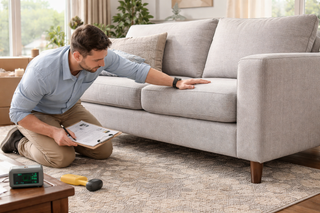
When I say “we tested this sofa”, I mean a repeatable process, not a quick sit in a showroom. Our team sits, lounges, naps, works, shifts, spills, cleans, and keeps notes long enough to see what improves, what holds steady, and what starts to slip.
This page explains how we test sofas, sectionals, recliners, and other living-room seating. I walk through the test steps, the role of each tester, and how our clinical advisor reviews comfort and support notes before we publish a verdict.
The point is simple: when you see a score or recommendation on Dweva, you should be able to trace it back to daily use, measurements, and repeated observations.
Table of Contents
- Our Testing Philosophy
- Meet The Sofa Testing Team
- How We Choose Sofas To Test
- Step 1 – Specs, Materials, And Build Review
- Step 2 – Assembly And Setup
- Step 3 – Comfort And Ergonomics Testing
- Step 4 – Couple Comfort And Motion Transfer
- Step 5 – Temperature And Breathability
- Step 6 – Durability And Structural Testing
- Step 7 – Fabric, Stain Resistance, And Cleaning
- Step 8 – Size, Layout, And Room Fit
- Step 9 – Safety, Stability, And Off-Gassing Checks
- Step 10 – Long-Term Use Diaries
- How We Turn Tests Into Scores
- How Dr. Walker Reviews Our Findings
- How Our Process Compares To Industry Approaches
- How We Keep Testing Independent
- How This Testing Helps Different Buyers
- Frequently Asked Questions About Our Sofa Testing
- How To Read Our Sofa Reviews With This Page In Mind
Our Testing Philosophy

Our method rests on three pillars: real-world use, structured measurements, and clinical review.
- We use couches the way people use them at home: with guests, snacks, laptops, kids, pets, naps, and long evenings in the mix.
- We measure details that change how a sofa feels, including seat depth, seat height, back angle, arm height, and cushion response.
- We have a physician with an ergonomics background review our comfort notes so posture and support claims stay careful.
This is not a lab-only protocol. We borrow useful ideas from structured furniture testing, then adapt them to the way seating behaves in a normal living room.
Meet The Sofa Testing Team

All sofa content on the site is written in my voice. I am Chris Miller, the lead tester and narrator. Alongside my own notes, each long-term seating review draws from six core testers who bring different body types, habits, and use cases into the same process.
Chris Miller – Lead Tester And Narrator
I stand around 5'10" and 185 pounds. Because I spend long days at a desk, I notice quickly when a sofa helps my lower back settle or pushes me into a slouch. On every test piece, I move through three positions:
- Upright with a laptop
- Semi-reclined “TV mode”
- Full stretch-out across the cushions
I focus on seat depth, back angle, lumbar contact, and whether softer seats make me slide forward during longer sessions.
For each sofa, I keep notes for at least three weeks. I compare day-one comfort with day-seven and day-twenty-one behavior, because a cushion that feels inviting at first can lose support once the same seat becomes the favorite spot.
Marcus Reed – Heavy, Heat-Sensitive Gamer
Marcus Reed stands about 6'1" and 230 pounds. He uses a couch the way many people use a media setup: long gaming sessions, late sports streams, and half-sleeping on the chaise.
Marcus tests edge strength, heat build-up on dense foam and thicker fabrics, frame flex, and overall stability under a heavier user.
In one deep modular sectional test, he slept on the chaise for three nights in a row. By the third morning, the hip-support drop was obvious enough to mark in the long-term notes. That kind of repeated use helps us separate soft comfort from early softening.
Carlos Alvarez – Work-From-Sofa Hybrid User
Carlos Alvarez weighs about 175 pounds at 5'11". He treats the sofa as a second office during the week: upright at first, laptop open, then gradually more reclined as the session goes on.
He watches mid-back and neck comfort, the transition between the seat cushion and back cushion at the lumbar area, and how stable the sofa feels when he moves from work posture to lounging.
When a sofa pushes his head forward or lets his mid-back collapse, he usually catches it before the rest of us do. His notes are especially useful for readers who work from the couch instead of only watching TV there.
Mia Chen – Petite Curl-Up Lounger
Mia Chen stands about 5'4" and 125 pounds. She often runs into the “feet off the floor” problem on deep couches, so she reads, scrolls, and watches TV while testing the corner and curl-up positions smaller users actually choose.
Mia checks seat height, seat depth, corner comfort on sectionals, and fabric feel on bare skin during longer lounging sessions.
Her notes tell us when a sofa crosses from cozy to hard to use for a smaller frame. A deep seat can look relaxed in photos but still leave her perched forward or disconnected from the back cushion.
Jenna Brooks And Ethan Cole – Couple Comfort Testers
Jenna Brooks sits around 5'7" and 160 pounds. Her partner Ethan Cole runs about 6'0" and 185–190 pounds. Together, they show us how a sofa behaves during normal couple use.
Jenna tracks how much she feels Ethan move, whether they can share the couch without crowding, and how easy it is to change positions. Ethan acts as the restless partner: he gets up, comes back, leans on armrests, and shifts toward one side.
When a sofa keeps both of them comfortable through a full movie night with snacks and plenty of movement, the couple-comfort and motion scores usually come out stronger.
Jamal Davis – Tall, Athletic Recovery Tester
Jamal Davis stands about 6'3" and 210 pounds. After sports or workouts, he uses the sofa to stretch, cool down, and sprawl out. Long legs expose support gaps quickly.
He pays close attention to thigh support, seat depth, knee angle, armrest height, and whether the back gives enough contact for a taller torso.
His notes show when a seat supports a tall user instead of making him feel folded up, perched, or forced into one narrow position.
Clinical And Ergonomic Advisor – Dr. Adrian Walker
Dr. Adrian Walker serves as our clinical and ergonomic advisor. He reviews tester notes through a medical and human-factors lens, especially when we discuss posture, pressure, and long-session comfort.
He does not sit on every sofa. Instead, he reviews measurement sheets, reads the long-form notes, and checks that support language stays grounded.
When we describe a seat as supportive for mild lower-back issues, that wording starts with repeated tester feedback and then gets narrowed after his review. His input is general guidance, not personal medical advice.
How We Choose Sofas To Test

We do not test only high-end or niche pieces. The mix usually includes entry-level budget couches, mid-range sofas and sectionals, plus premium and designer seating.
We also look at what regular shoppers actually encounter: popular online brands, big-box and chain-store sofas, direct-to-consumer companies that ship in boxes, and showroom lines that appear often in the market.
Selection depends on how often a model appears in buyer guides, how often it shows up in our sofa reviews, and whether the design is common enough to matter to everyday buyers.
Some models arrive as review samples. Others we buy at retail. Either way, we log the price, tested configuration, and upholstery choice before scoring begins.
Step 1 – Specs, Materials, And Build Review

Every test starts with a spec sheet and build review. I record the frame material, suspension design, cushion core, cushion densities when available, fabric content, and any stain-resistant finishes.
Commercial seating tests often focus on strength, repeated use, and safety. We do not claim to run industrial lab rigs, but those priorities shape what we inspect before the first long sit.
During this stage, we check staple patterns and corner blocks when visible, zippers and seams, stitching on cushion covers, lining inside removable covers, and how securely the legs attach.
If something feels flimsy before real use starts, it goes into the durability notes instead of getting buried under a first-impression comfort score.
Step 2 – Assembly And Setup

Next, we time assembly and setup. I open every box, lay out the parts, follow the manual, and log the total build time, number of steps, tool requirements, hardware alignment, and how smoothly bolts or connectors tighten.
For sofas that ship in several boxes, we also check part labeling, section connections, arm attachment, and stability once the frame locks together.
Jenna and Ethan help lift larger sections and judge whether one person could realistically handle the job in a smaller apartment, including whether the pieces would clear a doorway. Assembly problems do not change the comfort score, but they do affect how livable the piece feels from delivery day onward.
Step 3 – Comfort And Ergonomics Testing

Comfort and ergonomics testing sits at the center of the process. We combine structured measurements with subjective logs from people who sit, lounge, work, and stretch differently.
Key Seating Measurements
Using a tape measure and a digital angle gauge, we track seat height from the floor to the top of the cushion, seat depth from the front edge to the back cushion, backrest angle relative to the seat base, and armrest height from the seat surface.
We compare those numbers against a simple seated target: feet supported, lower back in contact, shoulders relaxed, and no sharp pressure behind the knees.
Then we test the numbers against different bodies. Mia checks foot contact and lower-back support, Jamal watches knee angle and thigh support, and I track lumbar comfort through a full movie or work session.
Sitting Positions We Test
Each tester follows the same repeatable block of positions:
- Upright sitting with feet flat and back against the cushions
- Semi-reclined lounging with the back sliding lower into the cushions
- Side-sitting or corner lounging, especially on sectionals
- Full stretch-out with legs on the sofa or an ottoman
We hold each position for at least 20–30 minutes, then log pressure at the hips, shoulders, and mid-back; any tingling or numbness in the legs; and how easy it feels to shift to the next position.
Dr. Walker later reads those notes to see whether the same problem repeats across testers or only appears for one body type or posture.
Lumbar Support And Back Comfort
Lumbar support often decides whether I call a sofa usable for long evenings. I check the space between my lower back and the back cushions, whether lumbar pillows flatten too fast, and whether the back cushions push my head forward.
Carlos runs two-hour work sessions on each sofa. He uses a laptop in the same posture each time and logs discomfort at regular intervals, which helps us see whether the sofa stays supportive or turns into a slouch trap.
Step 4 – Couple Comfort And Motion Transfer

A sofa can feel fine for one person and still fail for two. Jenna and Ethan help us track motion transfer and shared-space comfort.
They run the same set of tests each time: sitting side by side in the middle section, one person on the chaise while the other stays upright, and one person napping while the other shifts, stands, and sits again.
Jenna records how strongly she feels Ethan move. Ethan tracks how the cushions respond when he leaves and comes back. Together, they note whether one person loses comfort, whether the cushions slope toward the middle, and whether armrests or legroom become a problem.
On a separate night, Jamal may act as the heavier moving partner so we can compare movement across body weights.
Step 5 – Temperature And Breathability

Heat build-up matters for many readers. Marcus runs hot, and I notice warmth during long evening sessions, so we both track temperature and airflow.
We use each sofa for long evening sessions in similar room conditions, then note sweat, stickiness, clammy fabric feel, and how the surface feels after we stand up.
This test often exposes the trade-off between plush, dense cushioning and easier breathability. Marcus is useful here because he notices trapped heat quickly, while Dr. Walker reviews whether warmth is strong enough to affect restfulness.
Step 6 – Durability And Structural Testing

Full laboratory durability testing uses machines and repeated-load cycles. Our process focuses on stresses that show up in normal homes.
We look at real-life wear patterns: daily sitting and standing by lighter and heavier testers, repeated use of the same favorite spot, edge sitting while putting on shoes, and brief kneeling on cushions to reach shelves or windows.
Across several weeks, we log cushion sag in high-use spots, new creaks or frame noises, changes in levelness between sections, and loosening legs, brackets, or connectors.
On one recliner-style sofa, Jamal noticed a faint click under a footrest after about ten days. The fix was simple, but the issue still lowered the durability and quality-control notes because it appeared during normal use.
Step 7 – Fabric, Stain Resistance, And Cleaning

Every living-room sofa eventually sees spills or marks, so we test fabric behavior and cleaning in controlled ways.
Our routine includes applying small amounts of water, diluted coffee, and a light oil-based stain to an inconspicuous area, tracking absorption or resistance, and following the brand’s cleaning instructions exactly.
Daily fabric notes are split across the team. I check seam feel and texture, Mia checks bare-skin comfort, and Marcus watches whether the surface looks shiny, worn, or unchanged after repeated evenings.
For removable covers, we test zipper smoothness, removal and rehanging effort, and shape retention after cleaning. Stain behavior feeds into the care-and-maintenance score, which then affects the overall rating.
Step 8 – Size, Layout, And Room Fit

A sofa can feel comfortable on its own and still fail in a real room. To avoid that gap, we evaluate layout and fit in an actual living space.
We measure overall width and depth on the floor, clearance needed behind recliners or tilting backs, and ottoman or chaise projection into walkways.
Then we place the sofa in a test living room with a TV, side tables, and a normal traffic path. We check whether doors, drawers, or windows become harder to use, whether the chaise blocks movement, and whether taller testers bump into low backs or awkward angles.
This step keeps us from recommending a sofa that feels good in isolation but creates daily friction once it lands in a normal home.
Step 9 – Safety, Stability, And Off-Gassing Checks

Safety and stability still matter on living-room seating, so we check the basics before the long test period gets underway.
We push the frame from the front and side, check leg attachment on hard floors and rugs, and look for sharp corners or exposed staples in reachable areas.
We also track smell and off-gassing during the first days after unboxing. New foam and upholstered products can have noticeable odors, so we log initial intensity, describe the smell plainly, and recheck daily for at least a week.
Dr. Walker reviews those observations as general comfort guidance, especially for readers who are sensitive to smells in smaller spaces.
Step 10 – Long-Term Use Diaries

Some of the most useful data does not show up on day one. It shows up after the first few weeks.
For every sofa, we keep a shared diary. Each tester adds entries on assigned days, noting where they sat or lounged, how long they stayed, any pain or stiffness afterward, and changes in support, cushion feel, and fabric appearance.
A typical entry from me might say: “Worked upright for 90 minutes, mid-back fine. Watched a two-hour movie in semi-recline, slight sliding forward, needed a pillow under lower back.”
Marcus might write: “Three-hour gaming block. Seat under my usual spot feels softer than last week. Still supportive enough, but easier to bottom out when leaning forward.”
Those diary notes become the backbone of our real-world experience claims. When we say a sofa stayed supportive or started losing structure, the conclusion comes from repeated entries, not a single sit.
How We Turn Tests Into Scores

Behind every review summary is a fixed scoring framework. We adjust certain weights for special pieces, such as sleeper sofas or theater seating, but the core categories stay consistent.
Main Scoring Categories
We rate each sofa in the following areas:
| Category | Typical Weight | What We Look At |
|---|---|---|
| Comfort & Ergonomics | 30% | Posture support, pressure relief, position variety |
| Build & Durability | 25% | Frame, suspension, cushion resilience, long-term logs |
| Fabric & Maintenance | 15% | Feel, stain behavior, cleaning, cover design |
| Size & Layout | 10% | Room fit, configuration flexibility, everyday use |
| Couple & Motion | 10% | Shared comfort, motion transfer, seat sharing |
| Value & Warranty | 10% | Price versus build and comfort, policies, support |
Scores use a 1–5 scale for each category. A 5 means standout performance for the price band. A 3 means the sofa does the job but does not clearly pull ahead. A 1 means the issue is serious enough to affect how confidently we can recommend it.
How We Assign Numbers
We do not rely on one person’s taste. After the full test cycle, each tester submits scores for the categories tied to their part of the experience. I compile the averages, flag outliers, and compare the numbers against the written logs.
Dr. Walker reviews comfort, posture, and heat notes for red flags. If one person scores comfort high while another reports repeated pain, we look for the reason: body size, sitting position, tested configuration, or time spent in one posture.
Sometimes the result is split guidance rather than a single broad statement: great for taller loungers but less ideal for shorter upright sitters, or strong for couples who like firmer support but less appealing for solo nappers who want a deeper plush feel.
How Dr. Walker Reviews Our Findings
Dr. Walker’s involvement gives structure to our intuition. He reads our notes with three questions in mind:
- Does this sofa encourage healthy posture for at least one common sitting style?
- Do the reported pressure points line up with patterns that make ergonomic sense?
- Are we describing comfort and support in careful language instead of overstating the claim?
For example, if Mia reports that a deep sofa forces her to perch at the front edge, he connects that to smaller users losing back support. If Jamal says his knees sit too high because the seat is too low, he reads that as a likely fit issue for taller users.
His review may lead to notes such as “this seat depth may push shorter people into slouching” or “this medium-firm back gives clear lumbar contact.” Those comments do not replace medical care; they give readers a grounded way to think beyond soft-versus-firm labels.
How Our Process Compares To Industry Approaches
Furniture is usually evaluated in two broad ways: lab-style testing and editorial review.
- Lab-style testing focuses on repeated loads, safety, and structural failure points.
- Editorial reviews often focus on materials, feel, and personal impressions.
Our method sits between those models. We borrow the priorities behind durability standards without claiming to run full industrial tests, then add multi-week daily use, measurements, and comfort logs from testers who range from petite to tall.
The result is a scoring system tied to everyday living-room use rather than only first impressions or machine numbers.
How We Keep Testing Independent
Readers often ask whether free samples or partnerships affect our scores. The test structure is designed to keep that influence limited.
- Every sofa faces the same test list.
- Long-term diaries happen before final scoring, not after brand conversations.
- Negative findings about sag, creaks, hot fabrics, awkward sizing, or weak cleaning stay in the review even when the sofa came from a brand.
If a company sends a sample, we disclose that. If we return a piece or keep it longer for extended testing, we log that too. None of that changes the core ratings.
When reader feedback points to a problem we did not see, we try to reproduce it. If we can, we update the sofa review and adjust the score.
How This Testing Helps Different Buyers
Different readers come to our reviews with different needs.
- Shorter readers want to know whether a deep seat will swallow them.
- Taller readers want to know whether their legs and upper back feel supported.
- Couples want to know whether they can share a couch without feeling every movement.
- Hot sleepers want to know whether long movie nights feel sticky or breathable.
Our test steps match those questions. Mia’s logs speak to shorter users with dangling feet, Jamal’s notes help tall readers who stretch out, Jenna and Ethan show how a sofa behaves for two people, and Marcus highlights what dense cushions and synthetic fabrics feel like over longer sessions.
Dr. Walker’s perspective helps us decide when a specific seat profile deserves a stronger caution for certain body types or habits.
Frequently Asked Questions About Our Sofa Testing
How Long Do You Test Each Sofa?
We use each sofa for a minimum of three weeks in normal living-room conditions. Some pieces stay in rotation longer, especially models readers ask about often or designs that show slow changes over time.
Do You Test Recliners And Sectionals The Same Way?
The base protocol stays the same, but we add extra checks for the format.
For sectionals, we add more corner and chaise testing, plus more layout and room-fit checks. For recliners, we add extended footrest use, back-angle checks, mechanism feel, and noise notes.
Do You Only Test New Sofas?
Yes. We start with new-in-box products, just like a buyer would receive. Longer follow-up notes appear when we keep a sofa in the test space for months or longer.
How Do You Handle Different Configurations?
If a sofa line offers multiple depths, fabrics, or cushion types, we clearly state the tested configuration in the review. We only generalize when the underlying build suggests the same behavior across options.
Do Brands Influence Your Scores?
Brands can answer questions about specs or construction, but they do not set scores. When our testing shows a gap between marketing claims and real behavior, we say so.
How To Read Our Sofa Reviews With This Page In Mind
When you visit any sofa or sectional review on our site, the verdict should connect back to this page.
- “Great for tall loungers” comes from Jamal’s logs and our measurements.
- “Better for shorter sitters who stay upright” ties back to Mia’s and Carlos’s notes.
- “Runs hot in long movie sessions” usually reflects Marcus’s logs and my own evening use.
- “Supportive for mild lower-back issues” appears only after Dr. Walker has reviewed the pattern and agreed that the wording is careful enough.
If our reviews change, this page changes too. New research or better tools may refine how we measure, but the core idea stays the same: we test sofas the way people actually live on them, then document the process clearly.


